Kidney Stones: Symptoms, Causes, Treatment & How to Prevent Them
If you’ve ever experienced the sudden, gripping pain of a kidney stone, you’ll know it’s an experience few forget. Kidney stones are one of the most common urological problems in India — affecting roughly one in eight people — and the numbers are even higher in our hot climate, where dehydration is a major trigger. The encouraging news is that most kidney stones can be treated effectively, often without major surgery, and many can be prevented altogether. This guide from Shreeyash Hospital explains the symptoms, causes, treatment options, and the steps you can take to protect your kidneys.
What are kidney stones?
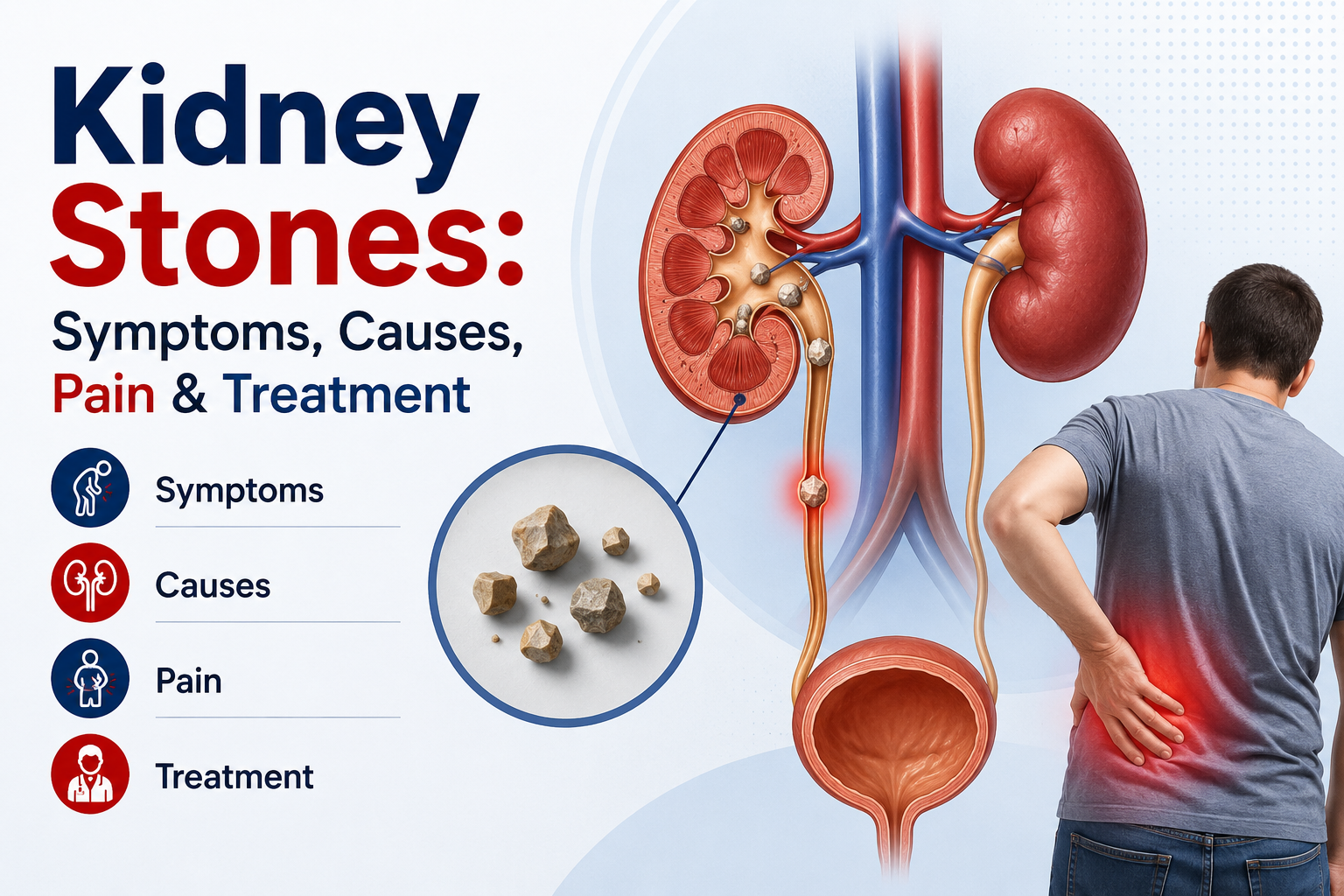
Kidney stones, medically known as renal calculi or urolithiasis, are hard, crystal-like deposits made of minerals and salts that form inside the kidneys. They develop when certain substances in the urine — such as calcium, oxalate, and uric acid — become too concentrated and crystallise. Stones can range from the size of a grain of sand to, occasionally, a much larger mass. Small stones may pass out unnoticed in the urine, but larger ones can get stuck in the ureter (the tube connecting the kidney to the bladder), causing intense pain and blocking the flow of urine.
Types of kidney stones
Not all stones are the same, and knowing the type helps prevent future ones. Calcium oxalate stones are by far the most common. Uric acid stones are linked to a high-protein diet and conditions like gout. Struvite stones are associated with urinary infections, and cystine stones are rare and run in families. Identifying the stone type allows our urologists to give you tailored prevention advice.
Symptoms of kidney stones
A small stone sitting quietly in the kidney may cause no symptoms at all. Trouble usually begins when it starts to move. The most common signs include:
Severe, cramping pain in the back, side, or flank that often radiates to the lower abdomen and groin (classic “loin to groin” pain), frequently coming in waves
Blood in the urine (hematuria), making it pink, red, or brown
Pain or a burning sensation while urinating
A frequent or urgent need to urinate
Cloudy or foul-smelling urine
Nausea and vomiting
Fever and chills — a warning sign of infection that needs urgent attention
What causes kidney stones?
The single biggest cause is dehydration — when you don’t drink enough water, your urine becomes concentrated and stones form more easily, which is exactly why stones are so common in hot regions of India. Other important factors include a diet high in salt, animal protein, and oxalate-rich foods (such as spinach, nuts, and chocolate), obesity, a family history of stones, certain medical conditions (urinary infections, gout, hyperparathyroidism), and some medications. Recurrence is common, which is why prevention matters as much as treatment.
When is it an emergency?
Most kidney stones are painful but not immediately dangerous. However, you should seek urgent medical care — including at our 24/7 emergency department — if you have severe pain that isn’t relieved by painkillers, fever and chills (a sign of infection), persistent vomiting, blood in the urine, or difficulty passing urine. A blocked, infected kidney needs prompt treatment to prevent complications.
How are kidney stones diagnosed?
Diagnosis is quick and accurate. At Shreeyash Hospital, evaluation typically includes a urine test (to check for blood, infection, and crystals), blood tests (to assess kidney function and stone-forming minerals), and imaging — usually an ultrasound or, where needed, a CT scan, which is the most precise way to confirm the size and exact location of a stone. For patients with repeated stones, additional metabolic tests may be advised to find the underlying cause.
Kidney stone treatment options
Treatment depends on the size, type, and location of the stone, and the goal is always to choose the least invasive effective option.
Small stones can often pass on their own with increased fluid intake, pain relief, and medication (such as alpha-blockers) that relaxes the ureter to help the stone move along.
Larger or obstructing stones may need a procedure, and modern urology offers several minimally invasive choices that avoid open surgery:
Shock wave lithotripsy (ESWL) — sound waves break the stone into tiny fragments that pass out naturally
Ureteroscopy with laser (URS / RIRS) — a thin scope passes up the urinary tract and a laser breaks the stone, with no external cuts
Percutaneous nephrolithotomy (PCNL) — keyhole removal of large stones through a small incision in the back
These techniques mean shorter hospital stays and faster recovery than traditional surgery.
How to prevent kidney stones
Because stones tend to recur, prevention is essential — and largely in your hands. The most important step is to drink plenty of water throughout the day, aiming for pale, clear urine, especially in summer. Beyond that: reduce salt in your diet, moderate animal protein, limit very oxalate-rich foods if you’re prone to stones, maintain a healthy weight, and treat any underlying urinary infections. A squeeze of lemon in water can also help, as citrate discourages stone formation.
Expert kidney stone treatment at Shreeyash Hospital, Sinhagad Road
Kidney stone pain shouldn’t be ignored or endured. Shreeyash Hospital in Kirkatwadi offers complete urology care — from accurate diagnosis to advanced, minimally invasive stone treatment — backed by 24/7 emergency services for those sudden, severe attacks. We’re easily reachable from Kirkatwadi, Narhe, Dhayari, Ambegaon and across Sinhagad Road.
📞 Book your consultation: +91 82377 79310 · Shreeyash Hospital, Kirkatwadi, Sinhagad Road, Pune
Frequently Asked Questions
What size of kidney stone needs treatment? Stones smaller than about 5 mm often pass on their own with plenty of fluids. Larger stones, or those causing blockage or infection, usually need a procedure. A scan confirms the right approach.
How can I make a kidney stone pass faster? Drinking plenty of water and taking prescribed medication can help small stones pass. Always consult a doctor if the pain is severe or you have a fever.
Is kidney stone removal painful? Modern treatments like laser lithotripsy and shock wave lithotripsy are minimally invasive and done under anaesthesia, so the procedures themselves are not painful, and recovery is usually quick.
What foods cause kidney stones? A diet high in salt, animal protein, and oxalate-rich foods (like spinach, nuts, and chocolate), along with not drinking enough water, increases the risk.
Can kidney stones come back? Yes, kidney stones commonly recur. Staying well hydrated and following dietary advice significantly reduces the chances of new stones forming.
When should I go to the emergency room for a kidney stone? Seek emergency care for severe pain unrelieved by painkillers, fever and chills, persistent vomiting, or inability to pass urine — these may signal a blockage or infection.
How much water should I drink to prevent kidney stones? Enough to keep your urine pale and clear — generally a good amount throughout the day, and more in hot weather or with physical activity. Your doctor can give you a specific target.
Can kidney stones be treated without surgery? Yes. Many stones pass with fluids and medication, and even larger stones can often be treated with non-surgical or scope-based laser methods rather than open surgery.
Yes. With the right treatment — especially laser surgery for advanced piles — most cases are resolved effectively, and maintaining good bowel habits keeps the risk of recurrence low.
Laser treatment is minimally invasive with no cuts or stitches, so pain is much less than with conventional surgery. Most patients experience only mild discomfort and recover quickly.
No. Early-stage (Grade 1–2) piles often improve with diet, lifestyle changes, and medication. Surgery is mainly recommended for larger, prolapsed, or persistent piles.
Bleeding from piles is common but should always be checked by a doctor, as similar bleeding can have other causes. Persistent or heavy bleeding needs prompt evaluation.
Most patients go home the same day and return to normal activities within a few days, with the piles shrinking over a few weeks.
Piles are swollen blood vessels, a fissure is a small tear in the anal lining, and a fistula is an abnormal tract near the anus. They share some symptoms, so a proper examination is important.
Yes, piles surgery is generally covered by most health insurance policies. Our team can help with the paperwork and cashless facilities.
Recurrence is uncommon after laser treatment, especially if you maintain a high-fibre diet, stay hydrated, and avoid straining.